Instagram’s Long-Form Pivot Was Telegraphed. Here’s the New Video Playbook
Instagram did not suddenly stop believing in short-form video.
It did something more useful: it started building a bridge from the clip that earns attention to the video that rewards it.
In January 2025, Instagram expanded Reels from 90 seconds to three minutes. In October 2026, it began a limited test of Features: horizontal videos up to 90 minutes, with linked Reels that can take viewers into the full video and a TV experience designed for deeper viewing.
That is not a longer-upload limit bolted onto Reels. It is a different content architecture.
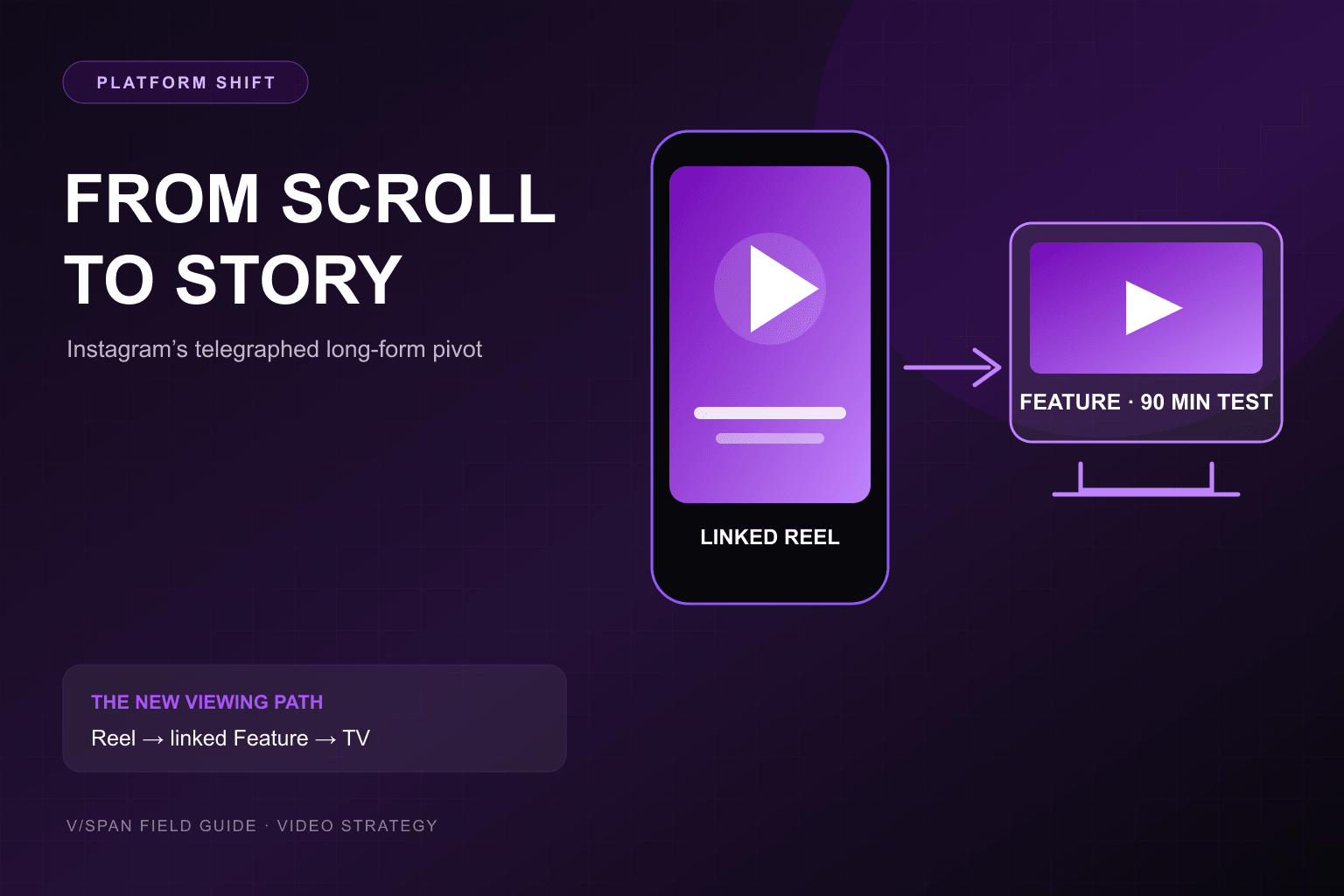
The short version
Instagram’s new model looks like this:
Discover through a Reel. Continue into a Feature. Return for a series.
For brands, the opportunity is not to publish the longest possible video. It is to stop treating every clip as a dead end.
A useful short video can now become the beginning of an in-app viewing relationship rather than a unit that must deliver the entire message by itself.
The duration signal
Instagram keeps adding room to continue the story
A separate long-form destination
A limited Features test adds horizontal video, linked Reels, and TV viewing. This is a test, not a universal upload limit.
01 · Discover
A linked Reel earns the next tap
02 · Continue
The Feature delivers the full idea
03 · Settle in
TV supports intentional viewing
The signals were already there
1. Three-minute Reels expanded the storytelling unit
In January 2025, Instagram head Adam Mosseri said the platform was raising the Reels limit from 90 seconds to three minutes because creators said 90 seconds was too short for the stories they wanted to tell. The Verge covered the announcement.
That change mattered even before 90-minute video arrived. It made room for:
- A complete answer instead of a fragment of one
- A setup, example, and payoff in the same Reel
- More useful interviews and demonstrations
- Clips that could stand alone without losing all context
The three-minute Reel was an early signal that “short-form” did not have to mean “as short as possible.”
2. Features gives long-form its own viewing context
The October 2026 test goes much further. Instagram is testing horizontal Features up to 90 minutes with selected creators, following an earlier test in Brazil. The format is aimed at podcasts, interviews, comedy, vlogs, and other videos that benefit from sustained viewing. TechCrunch’s report and The Hollywood Reporter’s coverage describe both the format and its initial rollout.
Two details are more important than the 90-minute ceiling:
Features are horizontal. Instagram is not pretending that the ideal container for a 45-minute conversation is the same vertical canvas as a 20-second Reel.
Features are designed for TV as well as mobile. That acknowledges a viewing behavior short-form strategy often ignores: sometimes people want to settle in, not keep scrolling.
Availability is still limited. Do not build a plan around an upload option your account may not have.
3. Linked Reels solve the handoff problem
The most strategically important addition is the link between the clip and the full video.
Before this, a podcast clip on Instagram usually asked viewers to leave the platform, find another app, search for the show, and relocate the right episode. Every step leaked attention.
With linked Reels, a viewer can move from a useful moment to the complete conversation inside Instagram. Instagram calls the clipping workflow “Clips as Reels”; the result is a native path from discovery to depth.
That is the pivot: not short-form versus long-form, but short-form connected to long-form.
4. Series and TV make return viewing part of the design
Instagram is also developing a dedicated home for episodic Reels and expanding its TV experience. The Publish Press overview connects these updates into a broader product direction.
A series changes the question from “How many views did this one asset get?” to “Did someone choose to watch the next idea?”
That is a much better question for brands with real expertise.
Why Instagram would reverse its earlier position
Mosseri had previously resisted long-form because he did not want it to weaken Instagram’s role in connecting friends. Short clips are easy to send, and those sends support that behavior.
The new design tries to preserve the sharing engine while adding a deeper destination behind it.
There are also clear strategic incentives:
- Keep the viewer relationship in-app. If Instagram creates the fan but another platform gets the full watch session, Instagram owns only the introduction.
- Give creators more durable formats. Interviews, explanations, and episodic shows can build a stronger return habit than disconnected clips.
- Create more viewing time and potentially more monetization inventory. Instagram has not announced a final long-form revenue-sharing model, so the business model remains an open question rather than a settled benefit.
- Meet the same viewer in different contexts. A phone in a feed and a television in a living room support different kinds of attention.
The duration changes are facts. These larger strategic interpretations should be tested against how the products actually develop.
What this does not mean
Short-form is not dead
Reels remain the discovery layer. A weak Reel does not become effective because a strong Feature sits behind it.
The opening clip still needs to make sense on its own. “Watch the full video for the actual answer” is not a hook; it is a withheld payoff.
Long-form is not automatically better
Ninety minutes is a maximum in a test, not a target. A useful eight-minute customer conversation is stronger than a 40-minute webinar recording with no point of view.
Duration should follow the number of ideas, the evidence required, and the viewer’s intent.
Your old webinar is not suddenly a native Instagram show
Long-form still needs editorial design. A registration pitch, housekeeping, and 12 minutes of waiting for attendees will not become engaging because the upload fits.
Start with the viewer’s question, not the archive you happen to have.
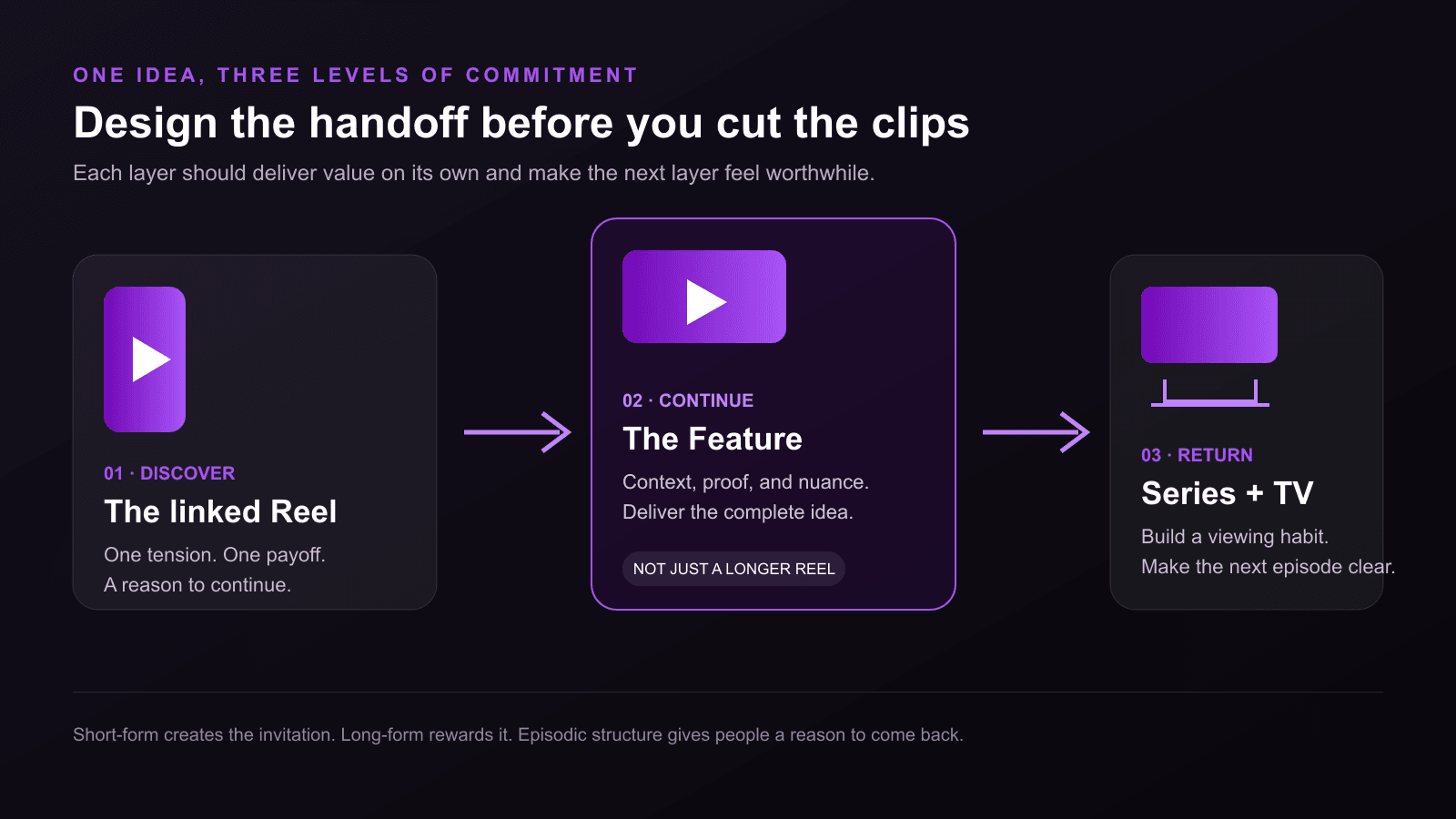
The brand playbook: build one idea at three depths
Start with a topic that deserves more than one answer. Then design each layer before recording.
Layer 1: Reels that deliver a complete small promise
Each Reel should contain:
- One recognizable tension. Name a problem the right viewer already has.
- One useful payoff. Offer a decision, example, or insight—not just a teaser.
- One reason to continue. Connect the small answer to the larger question in the Feature.
For example, a Reel might answer, “Why do global campaign videos start to look inconsistent?” The Feature can then show the complete workflow for fixing that inconsistency across regions.
Layer 2: A Feature with a real editorial spine
A strong long-form video needs chapters, even when the platform does not display formal chapter markers.
A practical 12–20 minute structure is:
- The question: What will the viewer understand by the end?
- The stakes: Why does the problem matter now?
- The example: What happened in a real situation?
- The framework: What can the viewer reuse?
- The resolution: What should they think or do differently?
Do not stretch this into 90 minutes because the format permits it. Twelve excellent minutes are a valid long-form product.
Layer 3: A series with a repeatable promise
Turn unrelated long videos into a recognizable viewing habit:
- Use a consistent question or audience
- Give episodes clear, specific titles
- Keep a stable visual identity
- Release in an intentional order
- Make the next episode a natural continuation
“Inside the Campaign: one global video system, examined region by region” is a series. “Marketing leadership videos, volumes 1–6” is a folder.
A production workflow that avoids extra shoots
Plan one substantial recording with the clips in mind, without turning the conversation into a pile of scripted sound bites.
- Write the central question. Keep it specific enough to guide editing.
- Outline six to eight moments. Include a contrarian point, a concrete example, a common mistake, and a practical framework.
- Record horizontally at high resolution. Protect a center-safe crop for vertical clips, and capture clean audio.
- Edit the full story first. The Feature should work without any knowledge of the Reels.
- Select clips that stand alone. Add the sentence of context each moment needs.
- Create platform-native versions. Reframe captions and graphics rather than shrinking the horizontal master.
- Link each Reel to the right Feature. Make the continuation immediate and relevant.
Our companion guides to talking-head framing across aspect ratios and using jump cuts with intent cover the production details.
Measure the handoff, not just the clip
Use the metrics available to your account and format. Avoid inventing a single “engagement score” that hides the behavior you actually want.
| Layer | Useful question | Metrics to inspect |
|---|---|---|
| Reel | Did the right people find it worth watching or sharing? | Average watch time, sends per reach, likes per reach |
| Linked handoff | Did the clip create interest in the full idea? | Feature starts or continuation clicks, if exposed |
| Feature | Did the longer video earn sustained attention? | Total and average watch time, drop-off points |
| Series | Did viewers come back for more? | Returning viewers, follows, next-episode viewing |
Instagram has identified watch time, likes per reach, and sends per reach as important ranking signals, with sends especially relevant to reaching non-followers. Buffer’s current algorithm guide summarizes those statements and the separate ranking systems across Instagram surfaces.
Do not compare a 30-second Reel and a 20-minute Feature by completion rate alone. Compare each asset with others doing the same job, then inspect whether the complete path is working.
A practical 30-day pilot
You do not need access to Features to prepare for this model.
- Week 1: Choose one audience question and outline a 12-minute expert conversation plus four standalone clip ideas.
- Week 2: Record with horizontal and vertical deliverables planned. Publish the first three-minute-or-shorter answer.
- Week 3: Publish two more clips, each with a distinct angle. Test whether the full answer performs better as one long Reel, a linked website video, or a Feature if your account has access.
- Week 4: Review watch time, sends, continuation behavior, and qualitative responses. Turn the strongest question into the next episode.
The goal is not to predict every product change. It is to build a content system that benefits whether the next layer lives in a Feature, a three-minute Reel, or your own video hub.
The real shift
Instagram’s long-form pivot rewards brands that can do two things well:
Compress an idea without making it shallow, and expand an idea without making it slow.
The brands that win will not be the ones with the longest videos. They will be the ones that design the clearest path from a useful moment to a meaningful viewing experience.
Read more
Unlocking Video Thought Leadership Success in 2026
Key insights from industry leaders on why video has become the gold standard for modern thought leadership—and how organizations can adopt it at scale.

How To Run a Winning LinkedIn Video Thought Leadership Strategy
Learn the exact strategy top creators and executives use to build influence, authority, and demand using LinkedIn video thought leadership.

How Executives Posting Branded Content to Their Personal LinkedIn Pages Can Massively Scale Organic Reach
Discover why executive-led posting is one of the most powerful and untapped organic growth strategies on LinkedIn, and how companies can operationalize it at scale.