What Is Brand Infrastructure for Video?
Every company has brand infrastructure for its written content. There's a style guide, approved logos in a shared drive, templates in the CMS, a review process before anything ships. Nobody thinks of these as optional, and nobody rebuilds them for each campaign.
Video almost never gets the same treatment. Most organizations produce video as a series of one-off projects: a new brief, a new vendor or editor, a new folder of files, a new debate about fonts and lower thirds. The result is predictable. Video is the most visible format the brand ships, and the least consistent.
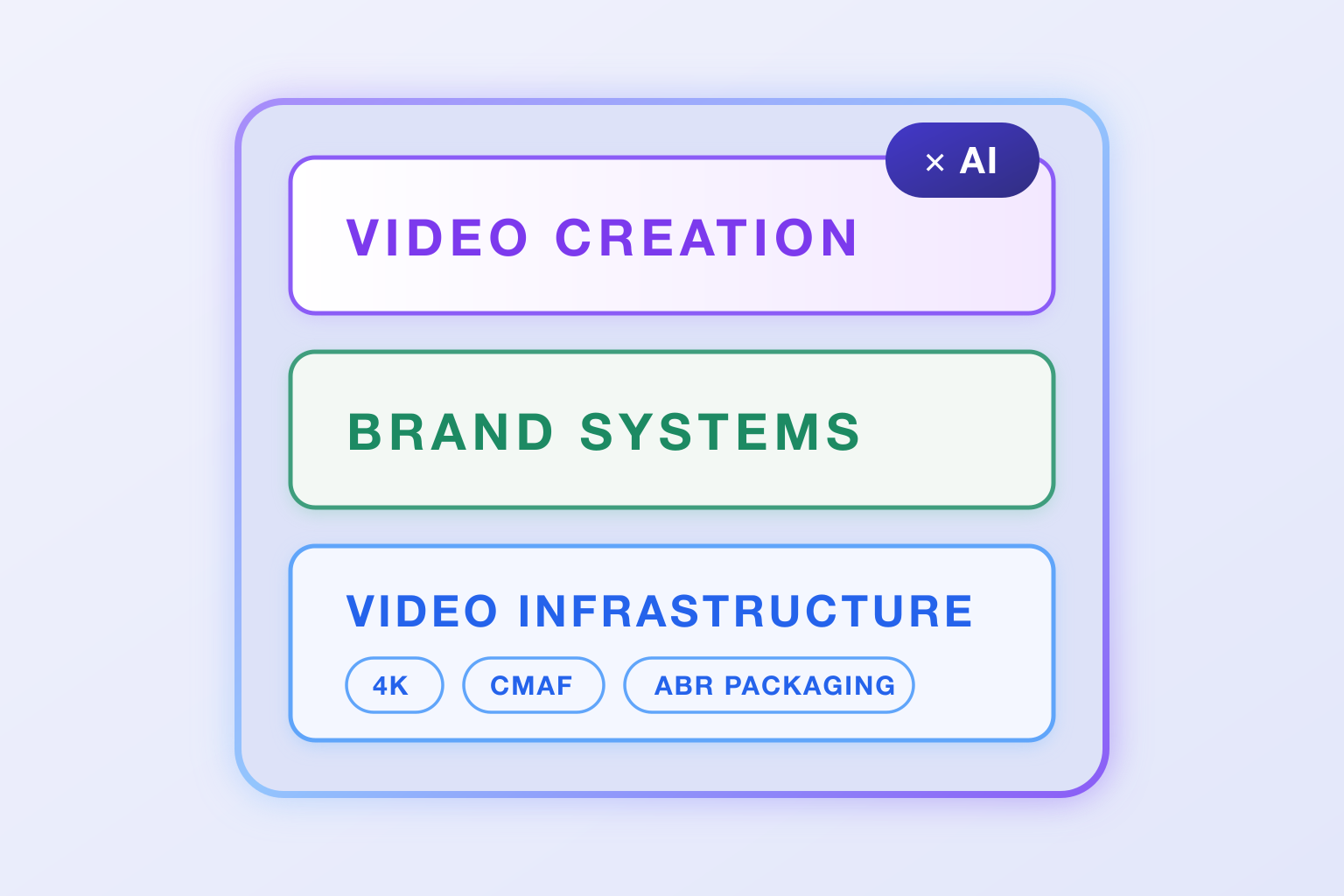
Brand infrastructure for video is the fix: the standing system of standards, assets, workflows, and governance that makes on-brand video repeatable, instead of something each project has to achieve from scratch.
A Working Definition
Brand infrastructure for video is everything that exists before a specific video project starts and persists after it ends:
- Standards: codified rules for how the brand looks, sounds, and moves on screen
- Assets: a governed, searchable system of record for footage, templates, and finished video
- Workflows: repeatable paths for capturing, editing, approving, and publishing video
- Governance: permissions and guardrails that let more people create without putting the brand at risk
If your written content runs on a style guide, a CMS, and an editorial process, brand infrastructure for video is the equivalent stack for your most demanding format.
Why "Infrastructure" and Not Just "Guidelines"
Plenty of companies have video brand standards, usually a PDF covering logo placement, color, and typography. Standards are necessary, but a document is not infrastructure. A document describes the right outcome; infrastructure produces it.
The distinction matters because of who makes video now. It's no longer just the brand team and an agency. It's sales sending prospect videos, HR recording onboarding, regional marketers localizing campaigns, executives posting to LinkedIn, and franchisees promoting locations. A PDF cannot keep hundreds of occasional creators on-brand. A system can, by making the on-brand path the easiest path:
- Templates that carry the brand automatically, so creators never touch a font menu
- Approved intros, outros, music, and lower thirds available at the point of creation
- Guardrails that lock what must not change and free what should be local
When the infrastructure does the enforcing, brand consistency stops depending on every individual creator having read the guidelines.
The Four Layers of Brand Infrastructure for Video
1. Standards: How the Brand Behaves on Screen
The foundation is a codified visual and tonal identity for motion: logo treatment, color, typography, motion behavior, audio identity, pacing, and tone of voice on camera. Critically, the standards should distinguish between what is fixed everywhere and what flexes by region, department, or channel. Ambiguity here is what creates the endless "is this on-brand?" review loops.
2. Assets: A System of Record for Video
Footage is a brand asset, and most companies treat it like exhaust. Finished videos, raw footage, b-roll, templates, and graphics scatter across drives, inboxes, and vendor hand-offs, so teams re-shoot what they already own and rebuild what already exists.
Infrastructure means one governed library where every asset is tagged, versioned, and searchable, including the ability to search inside the footage itself, by keyword, speaker, or visual content. When finding the approved clip is faster than re-shooting it, reuse becomes the default and consistency follows.
3. Workflows: Repeatable Paths From Capture to Publish
Every recurring video need deserves a standing workflow, not a fresh project plan. Executive updates, customer stories, event recaps, product announcements, localized campaign variants: each should have a defined path for how footage gets captured (guided, teleprompter-driven recording means no crew required), which template it flows into, who approves it, and where it publishes.
This is where the economics change. One-off production scales linearly with budget. Workflows scale with infrastructure: organizations running on this model cut post-production time by up to 90%, because most of each video already exists before the project starts.
4. Governance: Control Without Bottlenecks
The failure mode of brand control is a central team that reviews everything and becomes the bottleneck for everyone. The failure mode of speed is nobody reviewing anything. Governance infrastructure resolves the trade-off: role-based permissions, approval steps built into the workflow, and brand guardrails baked into templates so most content is safe by construction. Reviewers check judgment calls, not logo placement.
The Baseline: Streaming Studio-Grade Video Infrastructure
The four layers sit on a technical baseline that most brand conversations skip entirely: the infrastructure that stores, processes, and delivers the video itself. It is invisible when it works and brand-damaging when it doesn't. A perfectly branded video that buffers on a sales call, stutters in a keynote, or ships as a two-gigabyte email attachment undermines the brand as surely as the wrong logo.
Studio-grade means the same delivery technology the major streaming platforms run, applied to your organization's video:
- Adaptive bitrate streaming. Every video is encoded into a ladder of renditions at multiple resolutions and bitrates. Players step up or down automatically as network conditions change, so playback starts instantly and never stalls, whether it's a 4K display in the boardroom or a phone on hotel wifi.
- Package once, play everywhere. Segments are packaged with CMAF and served from CDN caches worldwide to both HLS and DASH players. Your onboarding video is delivered with the same mechanics Netflix uses for a season premiere.
- Cloud rendering. Edits, branded templates, and localized variants render in the cloud, so nobody waits on a desktop export or re-uploads a finished file. Changing a lower third or swapping a CTA is a re-render, not a re-project.
- Versioned delivery. Every published video keeps its version history behind a stable link. Fix a claim, update a price, or refresh a logo, and every place the video is embedded plays the new version immediately.
This baseline is also what makes the four layers above it work. Asset search needs instant preview and scrubbing. Workflows need fast, repeatable rendering. Governance needs versioned, auditable video rather than files forwarded through inboxes. Unlike the layers above, you shouldn't build this baseline yourself; you adopt a platform that provides it.
How to Tell If You're Missing It
The symptoms are easy to spot:
- The same footage gets shot more than once because nobody can find the original
- Every video project starts with "what's our template?" even though you've answered it before
- Regional and departmental video looks like it comes from different companies
- Legal or brand review is the slowest step in every project
- Video output rises and falls with agency budget instead of compounding over time
If written content behaved this way, with every blog post requiring a new CMS, a new style debate, and a manual brand review, you'd call it a broken operation. Video deserves the same standard.
Where to Start
You don't build all four layers at once. The sequence that works:
- Codify the standards you already enforce informally, and mark what's fixed versus flexible
- Consolidate assets into one searchable system of record and stop the scatter
- Template your top three recurring video types and route them through defined workflows
- Add governance last, once there's a system to govern: permissions and approvals on top of the paths people already use
Each step makes the next one cheaper, and the payoff compounds: every video produced on the infrastructure makes the library richer, the templates more proven, and the next video faster.
Infrastructure Is the Difference Between Producing Video and Operating It
Companies that win with video aren't the ones with the biggest production budgets. They're the ones where video works like the rest of the marketing stack: searchable, governed, reusable, and fast. That's what brand infrastructure for video delivers: not more video, better-performing video.
Videospan was built as exactly this layer: capture, asset search, branded templates, governance, and a system of record on studio-grade infrastructure, in one platform. Visit videospan.com to see it in action and book a demo with our team.
Read more
What Is Brand Infrastructure for Video?
Brand infrastructure for video is the system of standards, assets, workflows, and governance that makes on-brand video repeatable at scale. Here's what it includes and how to build it.

Empowering Global Teams: How Videospan Ensures Brand-Compliant Video at Scale
How Videospan helps distributed teams create consistent, brand-aligned video content—anywhere in the world.

Building a Scalable Video Strategy for Distributed Teams
A practical framework for helping remote and hybrid teams create useful, on-brand video without creating production bottlenecks or losing governance.